
Fast Track
•
Some teams are unmistakably themselves, whoever they play. They carry a recognizable style from match to match: the same passing shapes, the same partnerships, the same routes forward. Others reshape their game according to the opponent.
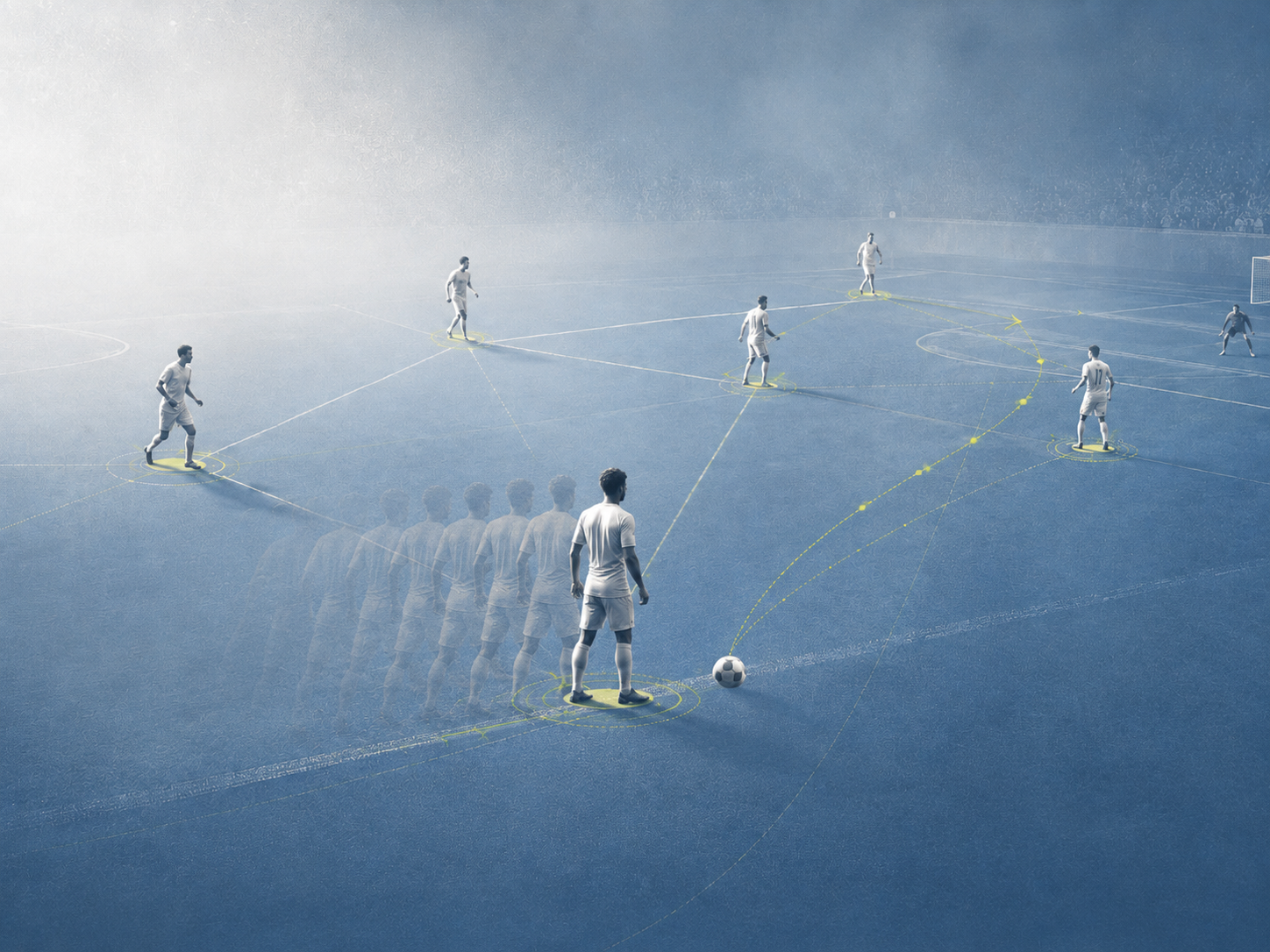
Gambeta used passing networks to treat each team’s style as a kind of fingerprint, testing whether World Cup teams had a clear identity, whether they kept it, and whether that helped separate the teams that reached the quarter-finals from those that did not. We measured each team’s identity across the tournament using match-by-match passing networks, supported by team- and player-level data.
Consistency shows how much a team repeats its own passing picture from game to game and stage to stage. It captures whether the ball is received by similar kinds of players in similar areas, whether the same combinations do the heavy lifting, and whether the team circulates the ball in similar ways before committing forward. Distinctiveness shows how far that picture departs from everyone else’s. Most teams at a World Cup fall into broadly familiar shapes; only a few are genuinely different. Put the two together and you have identifiability: a team that is both stable and distinct, one you could pick out of a line-up of forty-eight.
Team Passing Identity
The teams that reached the quarter-finals: Argentina, Belgium, England, France, Morocco, Norway, Spain and Switzerland, were, on average, a little more identifiable than the rest, as you can see in the chart below. Each dot represents a team.
Teams further to the right, such as the Netherlands, Switzerland and France, reproduced their own passing network most faithfully across the tournament. Teams higher up had the most distinctive build-up shape. The dark-red rings mark the eight teams that won their Round of 16 tie and reached the quarter-finals.

Just outside that group sits the chart’s main cautionary tale: the Netherlands were the most identifiable team in the tournament by this measure, yet went out in the R16 on penalties. A clear identity may help a team impose itself, but it does not guarantee progress, especially once a knockout tie reaches a shootout.
Impose or adapt?
There are two ways to survive a knockout tie. A team can impose its identity, play the game on its own terms, and trust that it is good enough. Or it can adapt, reshaping its build-up to the opponent. We can see which path each team took by comparing its knockout passing network with its group-stage fingerprint.
The second chart looks at what changed once the tournament became knockout football. It compares each team’s passing network after the group stage with the fingerprint it had already established.

The further right a team sits, the more its knockout matches resembled its own group-stage games. The quarter-finalists mostly lean that way, though not all in the same manner. France, Argentina and Spain combined continuity with strong progression, while Switzerland kept a very similar structure without carrying the ball forward as effectively.
England and Norway are useful exceptions: both advanced despite sitting on the more adaptive side of the chart. At the other end, the Netherlands and Paraguay stayed close to their group-stage identity, but with much weaker progression. The pattern points more towards imposing than reinventing, but identity only mattered when it still helped move the ball forward.
Hard to break
Identity shows whether a team is recognizably itself. It does not show whether that identity can withstand pressure. A passing game can look coherent and still break down if its main creator is marked out of the match. So the next question was about resilience: if you removed a team’s most important passer, or tried to split its network in two, how much of the structure would survive?

Teams in the upper right are the hardest to disconnect. Their passing networks have a larger core of players linked to one another, and it takes more intercepted passes to break the structure apart. Most of the quarter-finalists sit in this area.
In other words, the sides that went deep were, on the whole, more resilient. This is not a new idea: researchers found a similar passing signature in Spain’s 2010 champions, but it is striking to see it reappear at World Cup 2026.
Identity is not destiny
So does a clear identity win you a World Cup? Not on its own. The most distinctive team went home early, and a couple of quarter-finalists were, by our numbers, fairly ordinary in shape. What travelled with a deep run was the combination: a recognizable game, carried into the knockout stage rather than abandoned, built on a structure that was hard to pull apart and still turned possession into genuine progress.
Basic statistics tell us how much of the ball a team had. A network view asks something harder: was the team itself, was it hard to break, and did the ball actually go somewhere? At this World Cup, the sides still standing tended to answer yes to all three, while the exceptions remind us that a fingerprint is an identity, not a guarantee.